Signed in as:
filler@godaddy.com
Most people think of starch as a straightforward source of carbohydrate. But starch is surprisingly dynamic. How it's prepared can dramatically alter the way your body digests it.
Starch is made up of two glucose polymers: amylose and amylopectin. When foods such as potatoes, rice, oats and pasta are cooked in water, the starch granules absorb water, swell and lose their tightly packed crystalline structure. This process, known as gelatinisation, makes starch far more accessible to digestive enzymes.
As the food cools, some of these starch molecules begin to realign. The relatively straight amylose chains form tightly packed crystalline structures held together by hydrogen bonds. This process is called retrogradation. Once these crystals form, they become much more difficult for digestive enzymes to break apart. The result is resistant starch type 3 (RS3), a form of starch that largely escapes digestion in the small intestine.
In simple terms:
Cook → starch becomes highly digestible
Cool → starch recrystallises
Recrystallised starch → resistant starch
This explains why cooled potatoes, rice and pasta often produce a lower blood glucose response than their freshly cooked equivalents.
Resistant starch isn't a single substance. It's a group of starches that resist digestion for different reasons.
RS1 is starch that digestive enzymes simply cannot easily access because it is trapped within the physical structure of the food.
Examples include:
Grinding, blending and extensive processing can reduce RS1 because the starch becomes more accessible.
RS2 occurs naturally when starch granules have a tightly packed crystalline structure that human digestive enzymes struggle to break down.
Examples include:
As bananas ripen, much of this resistant starch is converted into sugar. This is why a green banana behaves very differently metabolically from a ripe one.
This is the form most people encounter when discussing resistant starch.
When foods such as potatoes, rice or pasta are cooked, the starch becomes digestible. As the food cools, some of the starch recrystallises into a new structure that resists digestion. This process is known as retrogradation.
Examples include:
This is arguably the easiest form of resistant starch to increase in an everyday diet.
RS4 is created through industrial food processing. Manufacturers chemically modify starch molecules to make them less digestible.
These starches are commonly used in:
Although technically a resistant starch, it differs substantially from the naturally occurring forms found in whole foods.
RS5 forms when amylose binds to fats and creates a structure that digestive enzymes struggle to access.
This can occur when starches are cooked in the presence of fats such as:
This is a relatively newer classification but is becoming an area of increasing research interest because it appears to combine some of the benefits of resistant starch formation with everyday cooking practices.
From a health perspective, the most practical sources are generally:
These forms occur naturally and have been consumed throughout human history. They also appear to be readily fermented by gut microbes, producing beneficial compounds such as butyrate.
While resistant starch is often discussed as a single nutrient, the reality is that a green banana, a lentil and a cold potato all contain resistant starch for completely different structural reasons. Understanding those differences helps explain why food preparation can be just as important as food choice itself.
Foods rich in amylose generally produce more resistant starch after cooling because amylose retrogrades more readily than amylopectin.
Good examples include:
Interestingly, repeated heating and cooling cycles may increase resistant starch formation even further, as each cycle provides another opportunity for starch molecules to reorganise into stable crystalline structures.
Contrary to popular belief, resistant starch isn't completely destroyed by reheating.
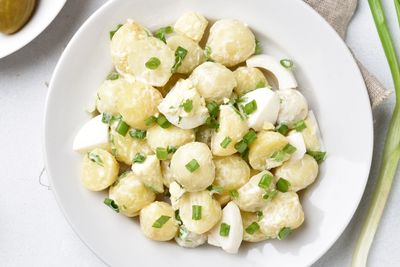
Once RS3 has formed, a significant proportion remains intact during gentle reheating. This means reheated leftover potatoes, rice or pasta typically still contain more resistant starch than when they were first cooked and eaten hot.
From a resistant starch perspective, surprisingly, yes.
Raw potatoes contain large amounts of RS2 resistant starch. However, this doesn't make eating raw potatoes a good strategy.
Raw potatoes are:
Cooking destroys most RS2 but greatly improves digestibility and nutrient availability. Cooling subsequently creates RS3. For most people, cooled cooked potatoes are the more practical option.
Interestingly, green bananas are one of the richest natural sources of resistant starch available. As they ripen, much of that resistant starch is converted into sugar.
Not really.
Uncooked pasta is certainly harder to digest because the starch granules remain largely ungelatinised, but it doesn't provide the same benefits as retrograded resistant starch formed after cooking and cooling.
The starch is physically inaccessible rather than intentionally transformed into a beneficial fermentable substrate. Eating dry pasta is also unlikely to be particularly enjoyable and may cause digestive discomfort.
Resistant starch behaves much more like a fermentable fibre than a conventional carbohydrate.
Instead of being digested and absorbed as glucose in the small intestine, it reaches the colon where it is fermented by gut microbes. This process produces short-chain fatty acids, particularly butyrate, which serves as a primary fuel source for colon cells and is associated with improved gut and metabolic health.
Perhaps the most fascinating takeaway is that a potato doesn't need to become a different food to behave differently in the body. Simply allowing it to cool changes the physical arrangement of the starch molecules, altering how your digestive system and gut microbiome interact with it.