Signed in as:
filler@godaddy.com
Spend enough time reading about nutrition and you start to notice a pattern. The conversation almost always revolves around a handful of familiar topics. Protein gets discussed endlessly. Carbohydrates are either praised or demonised depending on the latest trend. Fibre is finally receiving some of the recognition it deserves. Even vitamins and minerals, despite being discovered over a century ago, still dominate health headlines and supplement advertisements.
Yet there's a fascinating omission in all of this.
Many of the foods most consistently associated with long-term health benefits contain compounds that rarely appear on a nutrition label, aren't tracked in diet apps and are seldom mentioned in mainstream dietary advice. Coffee, berries, cocoa, olive oil, herbs, spices and colourful vegetables all seem to offer benefits that can't be fully explained by their vitamin content, calorie count or macronutrient profile alone.
Scientists have spent the last few decades trying to understand why.
Increasingly, the answer appears to involve a vast family of plant compounds known as polyphenols.
If you've never heard of polyphenols, you're not alone.
They're not regarded as essential nutrients in the same way as vitamin C or magnesium, which means most people can go through life without ever encountering the term. Yet we're exposed to them every day. Every cup of coffee, handful of berries, splash of olive oil or sprinkle of herbs brings hundreds of different plant compounds into the body.
What's particularly interesting is how different they are from one another. Researchers have identified thousands of individual polyphenols, each with unique structures and potentially unique biological effects. The compounds found in blueberries bear little resemblance to those found in coffee beans or extra virgin olive oil, yet all three foods repeatedly appear in discussions around healthy dietary patterns.
That should make us pause for a moment.
Because if foods with vastly different nutrient profiles are producing broadly similar health outcomes, perhaps we're looking beyond traditional nutrition labels for answers.
In many ways, polyphenols remind us that food is far more complicated, and far more interesting, than the numbers printed on the back of a packet.
If you've come across polyphenols before, chances are they were described as antioxidants.
That's technically correct.
It's also where the story usually stops.
For years, nutrition messaging told us that oxidative stress damages cells, antioxidants reduce oxidative stress and therefore consuming more antioxidants must be a good thing. It was a simple explanation, easy to understand and even easier to market.
The supplement industry embraced the idea enthusiastically.
The problem was that reality didn't always cooperate.
When researchers isolated antioxidant compounds and tested them in supplement form, the results often failed to match the benefits seen in populations eating diets naturally rich in polyphenol-containing foods.
If polyphenols were simply acting as little chemical shields against oxidation, those outcomes should have been much more consistent.
Instead, scientists began to suspect that something more sophisticated was happening.
Polyphenols appear to interact with cellular signalling pathways, inflammation, immune responses and metabolism in ways that extend well beyond traditional antioxidant activity. Rather than simply protecting the body from damage, they seem to participate in an ongoing conversation between our diet, our cells and our environment.
And that conversation becomes even more interesting when we start looking at the gut microbiome.
For many years, nutrition science focused on absorption.
That seems perfectly reasonable. We eat food, digest it, absorb the nutrients and use them to build and maintain the body. Nutritional value was often judged by how much of something entered the bloodstream.
Polyphenols presented researchers with a puzzle.
Many of these compounds aren't absorbed particularly well in the small intestine. By conventional thinking, that should have reduced their importance.
Instead, it turns out their journey may only just be beginning.
Further down the digestive tract lies the colon, home to trillions of microorganisms collectively known as the gut microbiome. Rather than disappearing unused, many polyphenols arrive there largely intact, where they interact with an incredibly diverse ecosystem of bacteria.
Some microbes break polyphenols down into smaller compounds that can then be absorbed and utilised by the body. At the same time, the polyphenols themselves help determine which microbial species thrive and which struggle. The relationship goes both ways. The food influences the microbes, and the microbes influence what happens to the food.
This represents quite a shift in how we think about nutrition. Perhaps the question isn't simply what a food does for us. Perhaps it's also what that food does for the trillions of organisms living alongside us.
Turmeric offers a fascinating example of this idea. Most discussions around turmeric quickly turn into discussions about curcumin, the bright yellow polyphenol that gives the spice its characteristic colour. The conversation usually centres around absorption. How much gets into the bloodstream? How can absorption be increased? Should it be taken with black pepper?
These are interesting questions, but they may not tell the whole story.
A significant proportion of curcumin isn't absorbed in the small intestine at all. Instead, it continues into the colon where it encounters the trillions of microbes that make up the gut microbiome. There, gut bacteria begin transforming curcumin into a range of smaller compounds that may themselves contribute to its biological effects. Researchers increasingly believe that part of turmeric's value may come from this interaction with the microbiome rather than absorption alone.
In other words, we've become conditioned to think that if a compound isn't absorbed, it's somehow wasted. But many fibres and polyphenols seem to exert some of their most interesting effects precisely because they reach the colon. Rather than feeding us directly, they feed the ecosystem living within us.
Coffee has had a strange journey through the world of nutrition.
Depending on the decade, it has been labelled harmful, beneficial or somewhere in between. One year the focus is caffeine, another year it's stress hormones, and another it's athletic performance.
Yet when researchers began examining the microbiome in greater detail, coffee revealed something rather unexpected.
A study published in Nature Microbiology identified one of the strongest dietary associations with a specific gut bacterium seen to date. Across multiple independent populations, people who regularly consumed coffee consistently showed a greater abundance of Lawsonibacter asaccharolyticus than those who did not. The finding was observed repeatedly across different cohorts, making it one of the most compelling examples of a food influencing the composition of the microbiome.
The study wasn't important because it proved coffee was a superfood.
It was important because it highlighted something much bigger.
Food isn't simply delivering calories, protein, vitamins and minerals. It's interacting with a living ecosystem. Every meal creates opportunities for certain microbial species to flourish while others become less abundant.
Coffee simply provided one of the clearest examples.
Much of the current excitement around polyphenols comes from their ability to shape the microbial environment within the gut.
Researchers are increasingly interested in how polyphenol-rich foods influence microbial diversity, gut barrier integrity and the production of beneficial compounds. Rather than acting through a single pathway, polyphenols appear to participate in a complex network of interactions involving both the host and the microbiome.
One bacterium attracting particular attention is Akkermansia muciniphila.
Although research is still evolving, higher levels of Akkermansia have been associated with favourable metabolic health and a healthier gut environment in numerous studies. Interestingly, there doesn't appear to be a single food responsible for increasing it. Instead, Akkermansia seems to thrive in the context of diverse, plant-rich diets containing a wide variety of fibres and polyphenol-rich foods. That idea comes up repeatedly in microbiome research. The gut rarely responds to a single miracle ingredient. It responds to variety.
The encouraging news is that polyphenols aren't hidden away in obscure superfoods costing a fortune online.
Many of the richest sources are foods that have been part of traditional diets for centuries.
Berries provide colourful compounds known as anthocyanins. Coffee is one of the largest contributors of polyphenols in many Western diets. Extra virgin olive oil contains unique polyphenols often linked to the benefits of Mediterranean-style eating. Cocoa, tea, herbs, spices, legumes and deeply coloured vegetables all contribute their own collection of compounds.
The foods richest in polyphenols tend to look remarkably similar to the foods your grandparents would recognise. Not powders. Just plants.
One of the best things about polyphenols is that increasing your intake doesn't require complicated meal plans or expensive supplements.
Most people could substantially increase their intake simply by making meals a little more colourful and a lot more flavourful.
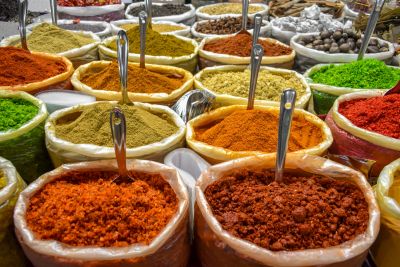
The biggest missed opportunity often isn't fruit or vegetables. It's the spice cupboard.
Herbs and spices are among the most concentrated sources of polyphenols in the human diet. They contribute very few calories, yet deliver an impressive diversity of plant compounds. Small habits can make a surprisingly big difference.
Add cinnamon to your morning coffee.
Stir cocoa powder into Greek yoghurt or kefir.
Use sumac on salads, eggs, roasted vegetables, hummus or grilled meat.
Add paprika to tomato-based sauces, soups and stews.
Cook with turmeric, cumin and coriander more often.
Be generous with rosemary, oregano, thyme and fresh herbs.
Scatter fresh parsley over dishes rather than using it as decoration.
Swap bland meals for colourful, aromatic ones.
Without really trying, you've increased both the flavour and the diversity of compounds reaching your gut.
A polyphenol-rich day doesn't need to look unusual. It could be coffee and yoghurt with berries, cinnamon and cocoa powder for breakfast. A large salad drizzled with extra virgin olive oil and topped with herbs and sumac for lunch. Lentils, beans or colourful vegetables cooked with turmeric, cumin and paprika for dinner. Nothing exotic. Nothing expensive.
Yet across the course of a day you've exposed your body and your microbiome to hundreds of different plant compounds that would never appear on a nutrition label.
Health messages like "eat the rainbow" can sound simplistic.
The phrase has been repeated so often that it's easy to dismiss it as another nutritional cliché.
Yet the science behind it is surprisingly compelling.
The deep blue pigments in berries, the reds in cherries, the purples in red cabbage and the vibrant colours of herbs and vegetables often reflect entirely different groups of plant compounds. Different colours frequently mean different polyphenols, and different polyphenols interact with different microbial species. Viewed through that lens, colour becomes about more than appearance. Colour becomes diversity.
And diversity appears to be one of the defining characteristics of a healthy microbiome.
Whenever science identifies a potentially beneficial compound, it's usually only a matter of time before somebody extracts it, concentrates it and puts it into a capsule.
Polyphenols are no exception. The challenge is that nature rarely packages nutrients in isolation.
A blueberry doesn't arrive with a single active ingredient. It arrives with fibre, polyphenols, water, vitamins, minerals and countless other compounds that interact with one another in ways we're still trying to understand.
Perhaps this helps explain why nutritional science repeatedly arrives at the same conclusion.
Whole dietary patterns tend to outperform isolated nutrients. The further we zoom in, the more complicated nutrition becomes. The further we zoom out, the clearer the message seems to be. Eat more real food.
The more we learn about nutrition, the less it seems to be about finding the perfect nutrient and the more it appears to be about creating the right environment.
An environment rich in diversity.
Diverse plants. Diverse fibres. Diverse polyphenols. Diverse microbes.
That's not a flashy message. It won't sell many supplements.
But it might explain why the foundations of good health still look remarkably similar to what they did before nutrition became obsessed with labels, macros and marketing claims.
Sometimes progress isn't discovering something new.
It's finally understanding why the old wisdom worked in the first place.